
AI-Powered VRI: Stopping Autumn Leaching Before it Starts
Precision water means precision compliance. Learn how AI-integrated Variable Rate Irrigation (VRI) prevents autumn nitrogen leaching and satisfies NZ council audits.
ENVIRONMENTAL AND COMPLIANCE
2 min read
AI-Powered VRI: Stopping Autumn Leaching Before it Starts
The Weekly Signal
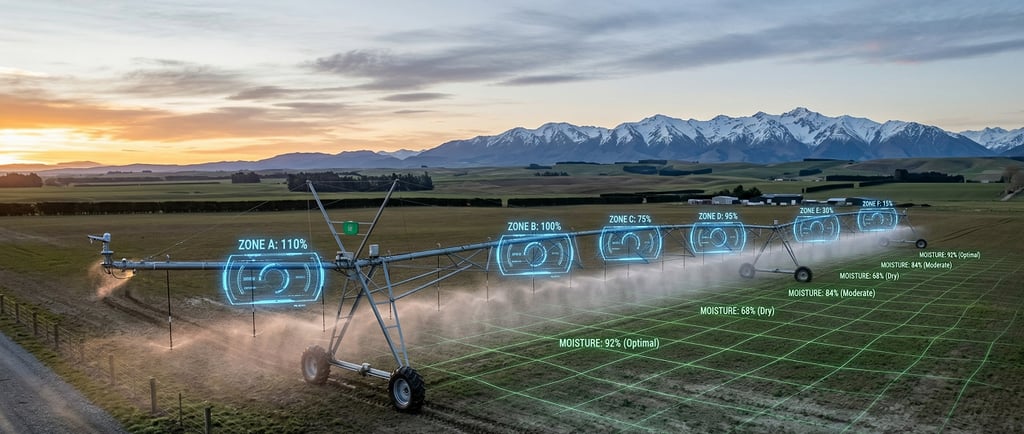
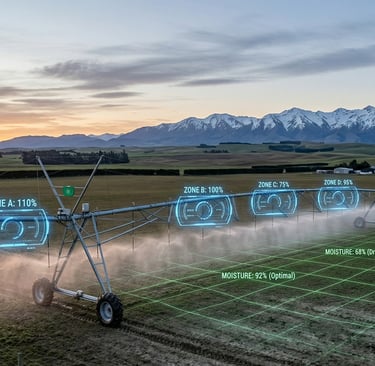
Variable Rate Irrigation is no longer just about adjusting pivot speed. It has evolved into AI-integrated systems that connect soil moisture sensors, weather APIs, and digital soil maps in real-time. This dynamic setup goes beyond static maps; the AI processes live data to shut off individual nozzles or spans over saturated zones, stock camps, or stony ridges. This precision ensures water—and the expensive nutrients dissolved in it—stops pushing past the root zone when soils are near field capacity.
Paddock Reality
Imagine your Canterbury light soils after a dry spell in April. Traditional irrigation might apply a blanket 15mm across the entire pivot circle. However, your AI-VRI system sees that the swales are still holding sufficient moisture from last week, while the gravel ridges only need 8mm to reach capacity. By uploading a real-time prescription via the cloud, the irrigator delivers only what is needed per zone, eliminating the overwatering that inevitably leads to high autumn leaching when the rains arrive.
Compliance Corner
The 2026 Bill places intense scrutiny on nutrient management plans and audited leaching data. Regional Councils are shifting from modeled averages to requiring precise records of water and nutrient application based on actual plant uptake. Utilizing an AI-integrated VRI system changes the conversation from defense to offense. You move from saying you tried not to leach to having a precise, sensor-verified audit trail proving zero water applied above field capacity in critical zones, satisfying even the toughest auditor.
The ROI Data
The actual numbers back up the technology: • Water savings: 20% to 30% reduction in total water use by eliminating overwatering in specified zones. • Energy reduction: significant drop in pumping costs due to lower volumes and fewer hours run. • Nutrient retention: keeps expensive fertilizer in the productive root zone rather than washing it into the groundwater.
Practical Access & Links
You can get this technology working on-farm through several providers operating in NZ:
• WaterForce with SCADAfarm VRI: Integrated control of precision irrigation via cloud-based platforms.
• Lindsay New Zealand (Zimmatic VRI): Advanced control panels and dynamic scheduling for pivots and laterals.
• Valmont New Zealand (Valley VRI): Customizable zone and speed control with integrated moisture data.
Farmer's AI Prompt
Copy and paste this into ChatGPT or Gemini to prepare your zone plans:
"I am a [Dairy/Arable] farmer in [Insert Region] with a 70-hectare center pivot on variable soils. Based on my latest EC map, identify critical high water-holding zones. Create a variable rate irrigation plan that reduces water application by 40% in those heavy zones during autumn to prevent nitrogen leaching while keeping the productive lighter soils at field capacity."